Restaurant scheduling problems are killing great restaurants — one Monday morning at a time.
Marcus has been awake since 5. Not because he wanted to be. Because his phone won’t stop.
Two missed calls from his sous chef. A text from his evening server: “Hey can’t make it tonight, family thing.” Another from the bartender he hired three weeks ago: “Running late, might be 30 mins.”
Marcus owns a 60-seat Italian restaurant in downtown Chicago. He’s been running it for 11 years. He loves it — the food, the regulars, the chaos of a Friday night rush when everything is firing perfectly.
But it’s Monday morning. And he’s already exhausted.
Before he’s had a single cup of coffee, Marcus is deep in schedule Tetris. Moving shifts around. Texting backup staff. Trying to figure out how to cover a dinner service that starts in 10 hours with two people down.
He’ll spend the next few hours doing this. Hours he doesn’t have.
Sound familiar?
The Restaurant Scheduling Problems Nobody Talks About
We’ve been building Scheduler Systems for a while now. We talk to a lot of restaurant owners. And here’s the thing nobody in this industry likes to admit out loud:
The number one reason restaurant employees quit isn’t pay. It’s scheduling.
Specifically, it’s not knowing when they work.
Schedules dropping 48 hours before shifts. Last-minute changes. Picking up someone else’s shift because a manager is desperate. Again.
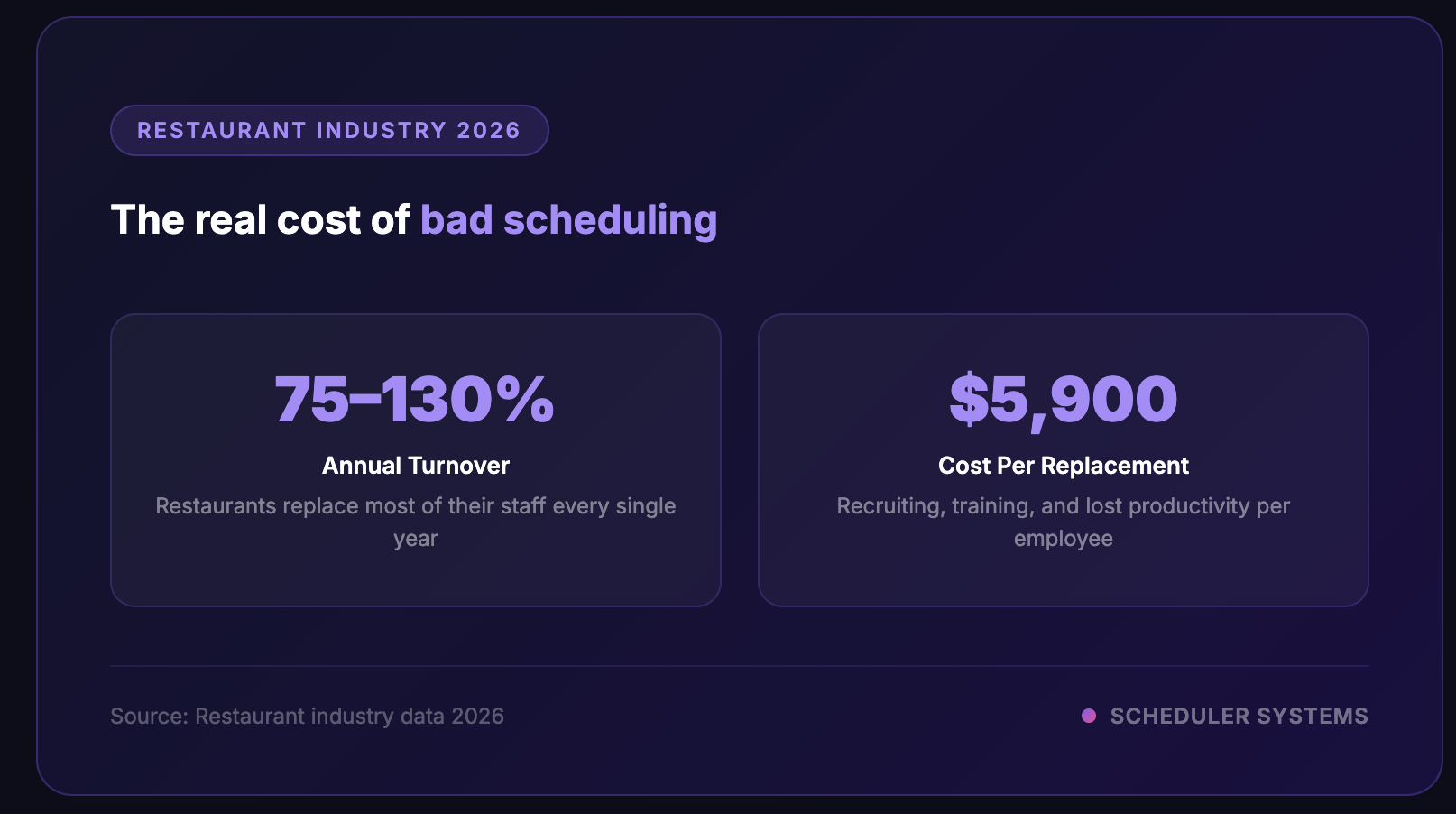
The data is clear. Turnover in restaurants sits between 75% and 130% annually. The average cost of replacing one hourly employee? Nearly $5,900 — according to a Cornell University Center for Hospitality Research study — when you factor in recruiting, training, and lost productivity.
For a restaurant with 20 staff members, that’s potentially $118,000 walking out the door every year.
Not because the food is bad. Not because the pay is terrible.
Because the schedule is chaos.
The 2025 Branch Report (surveying 2,300+ hourly workers across the US) found that 72% say understaffing regularly puts them under serious strain, and 93% report higher burnout when their team is short-staffed.
The restaurant scheduling problem isn’t new. But the solution is finally catching up.
Why Traditional Scheduling Is Broken
Most restaurants still build schedules one of two ways: a spreadsheet, or gut instinct.
Both fail for the same reason. They’re built on what the manager remembers — not what the data actually shows.
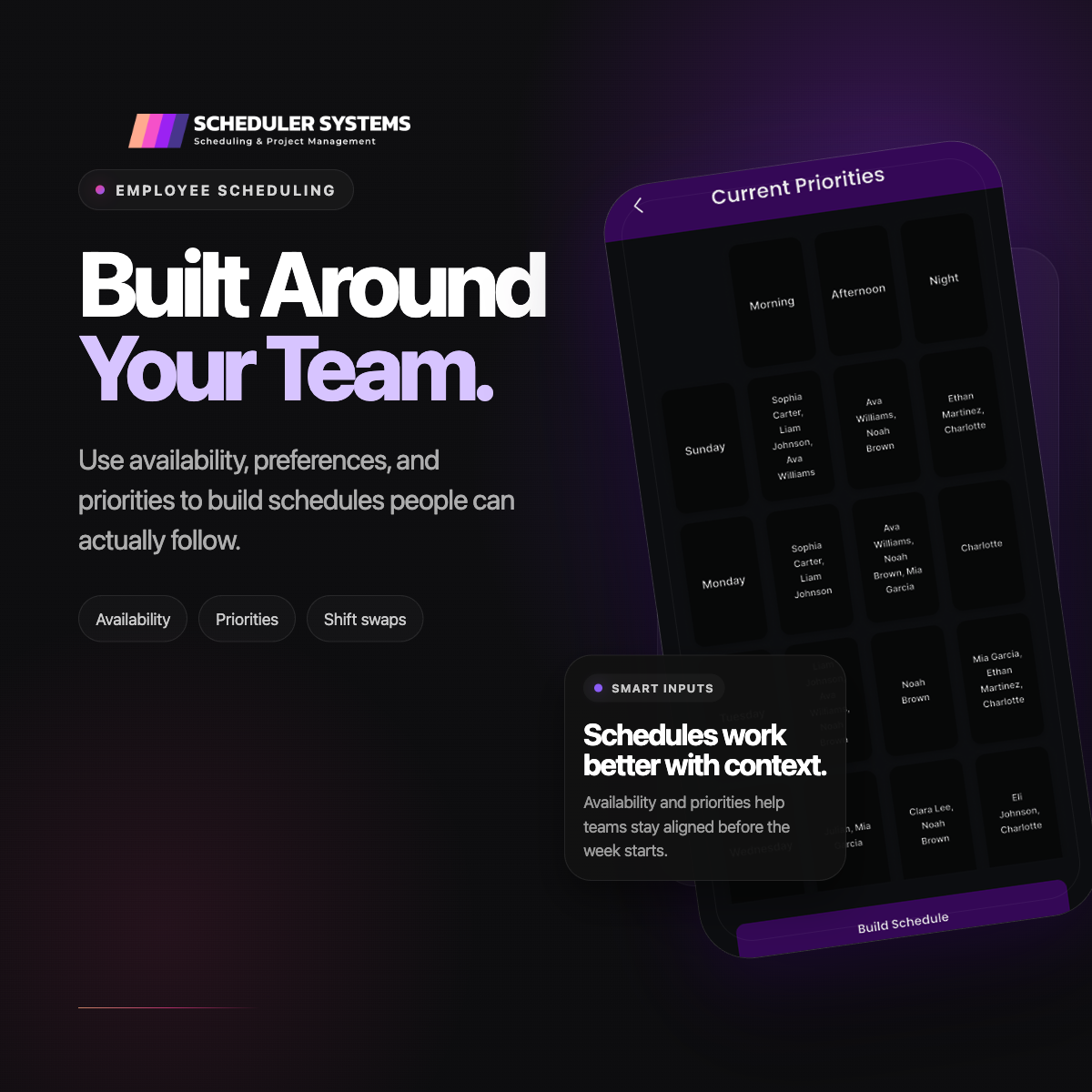
Here’s what that looks like in practice:
- Overstaffing on slow days — two extra servers on a quiet Tuesday costs $180 in wasted labor. Multiply that by 52 weeks.
- Understaffing on busy days — tables wait, customers leave, reviews suffer.
- Unfair shift distribution — the same three people always cover the bad shifts. They burn out. They quit.
- Last-minute callouts — no system to find replacements fast. Manager spends hours texting people who don’t respond.
These aren’t Marcus’s failures. They’re the system’s failures. And they’re costing restaurants more than most owners realise.
We’ve Been Thinking About Something
Here’s an idea we want to share. Not a finished product. Not a pitch. Just a thought we can’t stop thinking about.
What if Marcus had a Janet?
Janet is an AI assistant. Not a robot. Not a chatbot. Think of her more like a really capable colleague who never sleeps, never calls in sick, and never forgets what she’s been trained to do.
On Monday morning, when two people call out, Janet doesn’t panic. She already knows:
- Who on the team is available and wants extra hours
- Which shifts have been covered historically by which staff
- That Tuesday nights are slower, so she can move Tuesday’s backup to cover tonight
- That Carlos has covered for Maria three times this month — so fairness says it shouldn’t be Carlos again
She doesn’t make the final call. Marcus does. But instead of hours every week of phone calls and texts, Marcus spends 8 minutes reviewing what Janet already figured out.
He approves. The team gets notified. He goes back to his coffee.
This Isn’t About Replacing People
We want to be clear about something.
Janet isn’t replacing Marcus’s staff. She’s replacing Marcus’s Sunday night anxiety. His 6 AM scramble. The hours every Monday that slowly drain his love for the restaurant he built.
The best restaurant managers we know are incredible at the human stuff. Reading the room. Knowing that Sofia needs Wednesday off because her daughter has a recital. Understanding that putting Jake and Tyler on the same shift is a disaster waiting to happen.
That kind of judgment? No AI has it. Not yet. Probably not for a long time.
But covering a callout? Checking if labor costs are going over budget? Reminding a new hire that their shift starts at 5, not 6? Spotting that you’re overstaffed on slow Tuesdays and wasting $180 in labor every week?
That’s scheduling work. That’s Janet’s job.
What We’re Building: Hybrid Shifts
We’ve been calling this idea Hybrid Shifts.
The concept is simple. Your workforce isn’t just humans anymore. It’s humans and AI working alongside each other. You schedule both. You manage both. But the AI handles the repetitive, time-consuming parts so your managers can focus on what actually matters.
In Marcus’s world, a Hybrid Shift looks like this:
| Time | Human (Marcus) | AI (Janet) |
|---|---|---|
| 6 AM Monday | Wakes up to callout | Already flagged it at 5:58 AM |
| 6:05 AM | Reviews 3 options Janet prepared | Found available staff, checked fairness history |
| 6:12 AM | Approves one option | Sends notification to team |
| End of week | Focuses on food, guests, culture | Generates fairness report, flags overtime risks |
Marcus still runs his restaurant. He just has Janet running alongside him.
What We Don’t Know Yet
We’re not going to pretend we have everything figured out.
The honest truth: we’re building something new. And the most dangerous thing we could do is build it without talking to the people who will actually use it.
That’s you. The Marcuses of the world.
We have theories about what matters most. But we’ve been wrong before. We’d rather be wrong in a conversation than in a product nobody asked for.
So we want to ask you:
- What does your Monday morning actually look like?
- Where does your scheduling break down most?
- Is it the callouts? The fairness? The labor costs? The time it takes?
- If you had an AI assistant for one thing only — what would you give it?
We’re not trying to sell you anything right now. We’re trying to listen.
Try It Yourself
The Scheduler Systems app is free to download. It won’t give you Janet yet. But it will give you fairer, smarter scheduling right now — and it’s what Janet will be built on top of.
Talk to Us
If any of this resonates — if you’ve had that 6 AM Monday morning — we want to hear about it.
Click the chat button at the bottom right of this page. Tell us your story. Tell us what’s broken. Tell us what you wish existed.
Read our guide on fair shift scheduling to see how other restaurants solved this.
Because the best scheduling tool isn’t the one we imagine. It’s the one you actually need.
FAQ
What are the most common restaurant scheduling problems?
The most common restaurant scheduling problems are last-minute callouts, unfair shift distribution, overstaffing on slow
days, understaffing on busy nights, and managers spending 90+ minutes per week manually fixing schedules. All of these
contribute to the industry’s 75–130% annual turnover rate.
How much does poor scheduling cost a restaurant?
Poor scheduling costs restaurants an average of $5,900 per employee who quits. For a restaurant with 20 staff members and
typical turnover, that’s up to $118,000 per year — just from scheduling-related departures.
What is hybrid shift scheduling?
Hybrid shift scheduling is when both humans and AI agents work together to manage a restaurant’s schedule. The AI handles
repetitive tasks like finding replacements for callouts, checking fairness history, and flagging overtime. The manager reviews
and approves. Together they reduce scheduling time from hours to under 10 minutes
How can AI help with restaurant scheduling problems?
AI helps by automatically identifying available staff during callouts, distributing shifts fairly based on history,
forecasting busy and slow periods, flagging labor cost risks before they happen, and sending notifications to staff — all without the manager having to make a single phone call.
Written by the Scheduler Systems team — building the future of hybrid workforce scheduling. See how Scheduler Systems works →